
Home › Fees
Didpop fees, with the worked numbers
Three fee lines matter on Didpop: the agent service fee, the cross-border payment surcharge, and storage once the free window runs out.
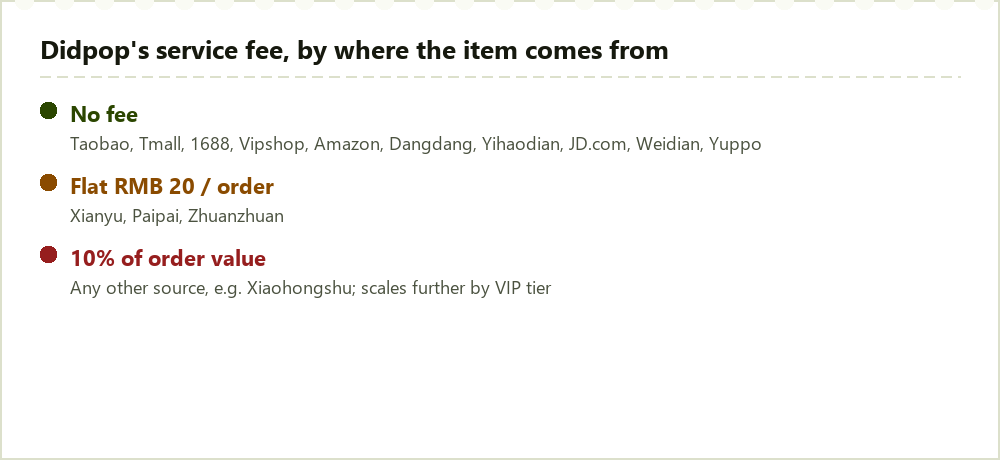
Service fee by source platform
Didpop's fee table is split by where the item is coming from, not by category. The three biggest general marketplaces, Taobao, Tmall and 1688, cost nothing extra, and the same zero markup applies to Weidian, JD.com, Vipshop, Yihaodian, Dangdang, Amazon and Yuppo. Three secondhand apps sit in their own bracket instead, Xianyu, Paipai and Zhuanzhuan, each billed a flat RMB 20 per deal regardless of what the item costs. Anything pasted in from somewhere not on either list, Xiaohongshu is Didpop's own example, gets billed a tenth of the order value, a percentage that moves further depending on VIP tier for that bucket specifically.
One detail worth knowing before you pay: on those 10%-fee orders, if you request a refund after paying but before the seller has shipped, Didpop's help article states the service fee itself is not refunded.
The cross-border payment surcharge, worked out
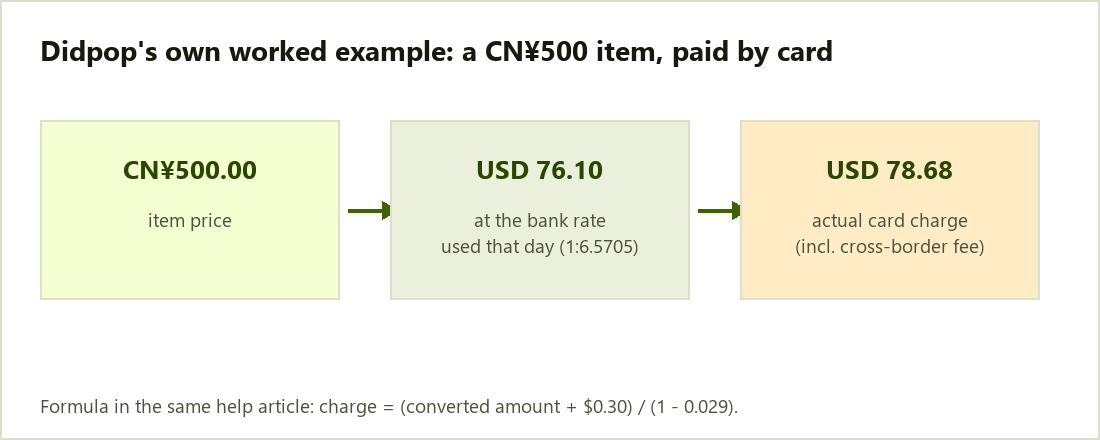
The archived help article states a 5% rate plus $0.30, but its worked example uses 2.9%. Reproducing the example shows how it was calculated; it does not prove that 5% is a typo or establish the payable rate. These are two conflicting historical statements. Didpop’s service was temporarily unavailable in the October 25 recheck, so this page cannot confirm a current checkout fee.
Take a CN¥500 item at a quoted rate of 6.5705 yuan per dollar: that converts to roughly 76 dollars and a dime before anything else is added. Push that figure through the formula (add thirty cents, then divide by 0.971) and the card gets billed 78 dollars and 68 cents, matching Didpop's published figure exactly.
Keep the two scenarios labelled. For any later available checkout, compare the CNY amount funded, the conversion rate, the percentage fee, the fixed fee and the final currency charge. Do not substitute the lower example rate for a quoted charge. The fee calculator and the archived formula are planning aids, not an offer to process a payment.
What else can cost money
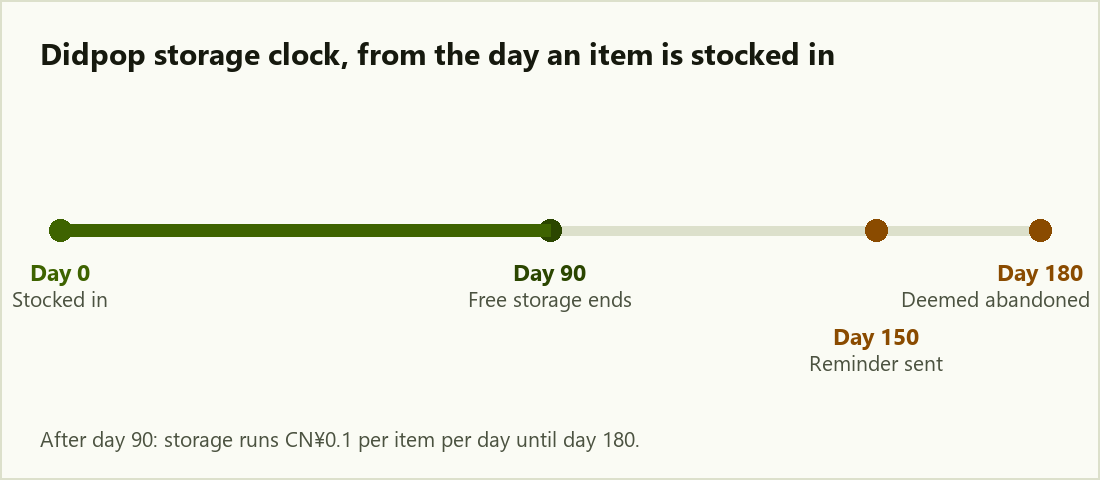
The clock starts the moment an item is marked stocked in, and the first three months sit free of charge. Past that point the meter runs at CN¥0.1 per item per day, a reminder lands in your account at the five-month mark, and the six-month mark is where Didpop treats an unclaimed item as abandoned and takes ownership of it. A parcel that arrives with nothing matched to an order in the system gets a tighter two-month deadline instead, and that one comes with no reminder at all.
For an existing warehouse item, record its stocked-in date and order number before discussing a deadline with support. Separate a request for another photo from an instruction to dispatch: the first seeks evidence, while the second commits to a parcel. The QC reference explains the inspection limits, and Help lists the archived contact route. Service availability and actual account status must be confirmed separately.
Beyond storage, the paid add-ons worth budgeting for if you want them are Secondary Quality Inspection, Detailed Photo or Video capture, Model Try-on Photos, and a handful of packaging upgrades (stretch film, a wooden case, a moisture-barrier bag) for fragile or high-value shipments. All of it sits on top of the two checks that already cost nothing, Standard Inspection and Standard Photo, and none of it is required to use either one.
What the published numbers do not cover
Two things affect your actual bill that Didpop's help center references but does not fully publish. VIP tier changes the 10% out-of-network service fee further, but the tier thresholds and the exact adjusted percentages are not laid out in the fee-standards article itself; expect your real rate to differ slightly from the flat 10% once your account has an active tier. New-user and promotional discount codes work against international shipping specifically, not against the item price or the service fee, and no guaranteed starting value is published for a new account.
A second worked example, for scale: a CN¥2,000 item at the same 6.5705 rate converts to about USD 304.39 before the surcharge, and running that through the same formula (amount plus $0.30, divided by 1 minus 0.029) puts the card charge at roughly USD 313.79, about 3.1% above the converted price. The percentage impact shrinks slightly as the order gets larger, because the flat $0.30 component matters less relative to a bigger number.