
Home › Shipping
Shipping and volume weight on Didpop
Two things decide most of a Didpop shipping bill: which line you pick, and whether your parcel's dimensions push it into volume-weight billing.
How packing choices move the final bill
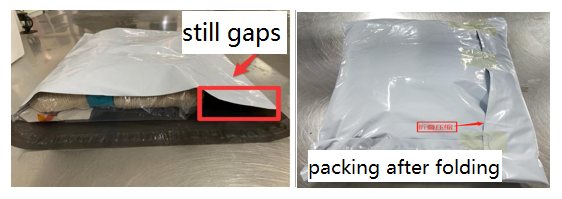
Didpop's own packing guidance shows the difference folding makes: an original retail carton with air gaps around the product gets trimmed down before it ships, because excess box volume is billed as if it were product weight on lines that bill by volume. The same help article walks through pressing garments flatter inside a poly bag rather than shipping them in their original folded retail packaging when that packaging is mostly empty space.
This matters more than it sounds like it should. A jacket that ships in its original oversized retail box can cost noticeably more in freight than the same jacket shipped in a trimmed poly bag, purely because of the box's dimensions, with the item's actual weight barely changing.
How Didpop bills volume weight
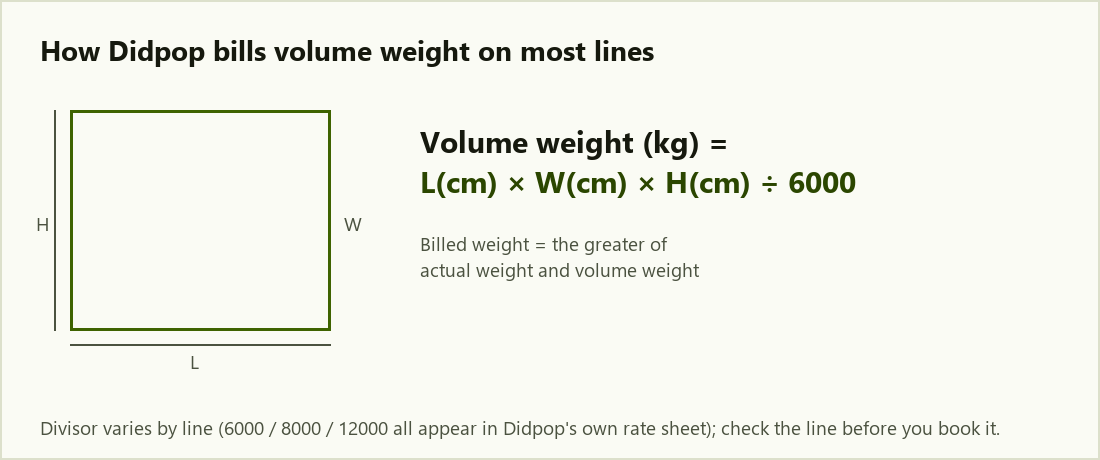
Most lines on Didpop's own rate sheet bill whichever number comes out larger: the real scale weight, or a volume figure worked out by multiplying the box's three measurements together and dividing by a number tied to the specific line. That divisor moves around; Didpop's own sheet uses 6,000, 8,000 and 12,000 on different lines, so identical box dimensions can produce three different volume weights depending purely on which option you pick.
A handful of lines bill differently again: some charge on actual weight only regardless of box size, and a few premium express lines switch the divisor to 5,000, which makes volume weight bite harder. Checking the specific line's billing method before you book it is worth the extra minute, especially for anything bulky but light, like a jacket or a pair of shoes in its original box.
Mail restrictions
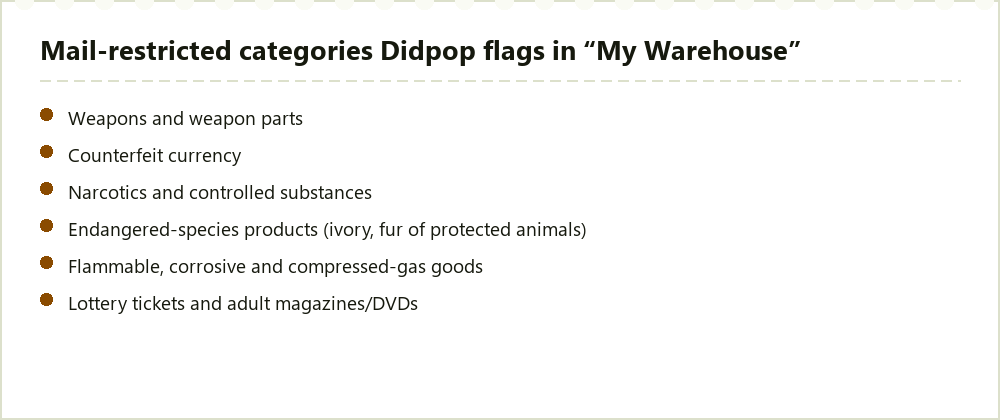
Didpop's logistics help section keeps a dedicated list of items it will not forward internationally, covering the same broad categories most cross-border carriers restrict: weapons and weapon parts, counterfeit currency, narcotics and controlled substances, endangered-species products, flammable or compressed-gas goods, and a short list of adult and lottery items. Once something flagged this way reaches My Warehouse, Didpop marks it with a dedicated prohibited icon rather than silently holding it.
If you are ordering something borderline (battery-powered electronics, anything liquid, anything that could be mistaken for a real weapon), check Didpop's Mail Restrictions article before you order rather than after the item is already sitting in the warehouse flagged.
Packaging upgrades for fragile or bulky shipments
Beyond the folding and trimming covered above, Didpop's help center names several paid packaging services for items that need more than a standard poly bag: Stretch Film for bundling odd-shaped items together, a Wooden Case for genuinely fragile or high-value pieces, a Moisture Barrier Bag for anything sensitive to humidity on a long sea or air route, EPE Loose Filling and a Corner Protector for cushioning inside a box, and Vacuum Packaging for compressing soft goods down to a smaller shipped volume.
None of these are needed for an ordinary order; they exist for the minority of shipments where a damaged or crushed parcel would cost more than the packaging upgrade itself. If an item is worth insuring against transit damage, mention the specific packaging service by name in your order remarks rather than assuming the warehouse will pick the right one on its own.
Delivery time and customs
Didpop keeps a dedicated Features of different types of Delivery article covering how its shipping options differ beyond price, and a separate The customs inspection article on what happens if a parcel gets pulled for a customs check once it leaves the warehouse. Neither article publishes a fixed transit-time guarantee across all lines, since actual delivery time depends on the specific line, the destination country, and whatever customs does with a given parcel on a given day, none of which Didpop controls end to end.
If a quoted delivery window matters more to you than price, read the specific line's own description before booking rather than assuming every line behaves the same; Didpop's own rate sheet groups lines by name, not by a universal speed tier.